

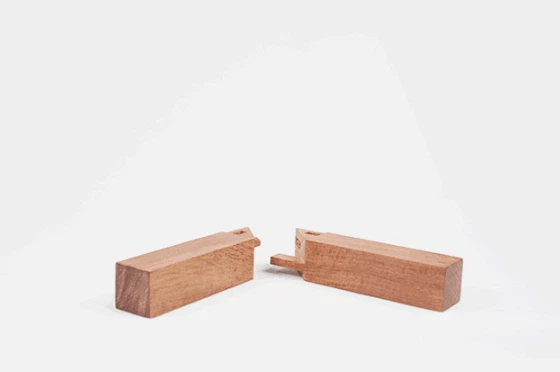
Toothed Form
Toothed form of solid wood paneling types. Tooth shaped, also known as finger shaped, should be machined out of two or more teeth at the joint of the solid wood narrow board before the board is put together, using the glue withering agent glue pressure joint of a solid wood board form.
The surface of the splice is flat and the strength of the splice is higher due to the increased gluing surface, but the processing of the splice is more complex.
Insert Mortise
This is a form of solid wood joinery in which the flat face and the round or square tenon are glued and pressed together using gluing wattle.
This form of jointing is an extension of the flat jointing and has a higher strength than the flat jointing. The hole processing accuracy is high, especially when using square tenon splicing, the square hole processing is complicated, the processing accuracy is low, it is difficult to ensure the quality of splicing.
Pierced jointing
A form of pierced piecing in the solid wood piecing type. The plywood is generally used as the splicing slats and the joint surface is glued and pressed with glue.
With the use of strips, the jointing strength is high, the processing is simple and the boards are easily aligned. It can prevent unevenness. However, the low production efficiency limits the widespread use.
Taping
A form of strip jointing within the solid wood type of veneer. The strip joint is a form of solid wood paneling in which a wedge-shaped groove with a dovetail cross-section is machined into the top of a narrow solid wood panel and a corresponding wedge-shaped strip is inserted, the panels are joined together in a flat or other form and the joints are glued together using adhesive. The joint strength is high, and the strip is also used to prevent deformation of the panels.
Concealed screw
The dark screwed form of solid wood paneling is a form of solid wood paneling in which a spoon shaped hole is cut on one side of the joint and a screw is screwed on the other side, the screw head is inserted into the round hole and pushed into the narrow slot and the other joint surfaces are glued with adhesive.
The surface of the concealed screwed panel does not leave traces and the strength of the joint is high, but the processing is very complicated and is not used much in modern furniture production.


